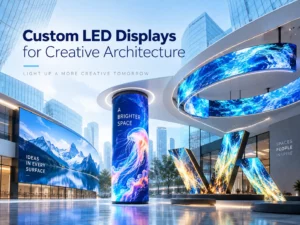
A custom LED display becomes useful when the architecture stops behaving like a flat rectangle. Curved walls, columns, cylinders, rings, suspended forms, spherical structures, and irregular facades all create the same practical question: how do you keep the visual idea without creating a screen that is difficult to manufacture, install, map, or maintain?
That question matters because a creative concept is not yet an LED system. Before production, the geometry has to be translated into modules, cabinets, structural interfaces, pixel maps, service paths, power routes, and content dimensions. That custom shaped LED display succeeds when those decisions are coordinated early rather than solved one by one on site. For architects, AV integrators, contractors, and project owners, the goal is therefore not to ask for “any shape.” The goal is to define a creative LED display that can be built repeatedly, aligned accurately, serviced safely, and supplied with a content canvas that the media team can actually use. Projects with defined geometry, viewing conditions, service strategy, and delivery requirements can be reviewed against SYVISO creative and custom display solutions.
A standard rectangular wall benefits from repetition. Cabinets can follow a regular grid, the resolution is easy to calculate, and the content canvas usually stays rectangular. Creative architecture changes that logic because the display has to follow another object: a column, curve, ceiling feature, sculpture, façade edge, or branded spatial concept.
Pixel pitch matters, but it is rarely the first number to lock for a custom shaped LED display. Start with the physical geometry: overall dimensions, radius, curve direction, openings, corners, transitions, installation depth, and the expected viewing path.
A curved LED screen with a gentle concave radius may be achievable with angled cabinet connections. A tight cylinder may need flexible modules or a different module layout. A sphere, ring, wave, diamond, or multi-face form can require project-specific module and cabinet engineering.
If the radius or overall dimensions change after the cabinet layout has been developed, the change can affect the module grid, structural frame, cable routing, pixel map, and content template at the same time.
For serious B2B projects, a sketch communicates intent but is not enough for engineering. The project team should provide dimensioned drawings, radius information, reference surfaces, mounting zones, openings, and available service depth. CAD or 3D geometry is especially valuable where several curves or non-planar surfaces meet.
The same package should identify what must stay visually clean. Some architectural projects allow hidden service doors or rear corridors. Others require the display to sit flush inside finished millwork or decorative cladding. Those constraints can change the cabinet and maintenance strategy before a final custom LED display configuration is selected.
“Custom” does not mean every project needs a completely new module. One of the first engineering decisions is choosing the simplest structure that can reproduce the intended geometry accurately.
Large-radius curves and faceted surfaces can often be formed by joining rigid cabinets at controlled angles. This approach keeps much of the familiar cabinet architecture while allowing the finished surface to follow a curve or polygon.
For a curved LED screen, the important checks are the permitted connection angle, visible transition between cabinets, final radius, structural attachment, and whether the content remains visually smooth from the main viewing positions.
This route is attractive when the architectural shape can be approximated cleanly without requiring every module to flex.
Columns, cylinders, tight curves, waves, and other continuous surfaces can call for flexible LED modules. More unusual forms may go further and use shaped modules, custom cabinet structures, or purpose-built mechanical interfaces.

Project-specific LED systems from SYVISO can adapt dimensions, cabinet structures, maintenance methods, and curved, cylindrical, spherical, or special-shaped geometry. The broader product range can be considered alongside the site geometry before the mechanical format is finalized.
A creative LED display should still be treated as an engineered system. The choice between rigid, flexible, and fully custom construction needs to account for geometry, viewing distance, installation, service access, and production repeatability rather than shape alone.
A custom LED video wall is not only a mechanical object. The media server and content team eventually need a precise digital canvas that matches the physical pixels.
On a flat rectangle, pixel count follows screen width, height, and pitch. Irregular geometry can create a canvas that no longer behaves like a standard 16:9 screen.
A cylindrical display may wrap content around a surface. A ring can contain empty space in the center. A spherical structure can require shaped modules and a non-rectangular mapping strategy. Even a simple curved LED screen changes how the audience sees perspective from different positions.
Before content production begins, confirm the active display area, native pixel map, module boundaries, non-display zones, reference viewing position, and any scaling or distortion-correction workflow.
The content team should not have to reverse-engineer the display after installation. A useful handoff includes the approved pixel dimensions, aspect or mapping template, active areas, orientation, and controller or processor requirements.
In a custom LED video wall used in a brand center, museum, showroom, or experiential retail space, this step is especially important. Creative content often crosses the whole structure rather than staying inside isolated rectangles.
Early coordination also prevents a familiar problem: the hardware is physically complete, but the final artwork has to be cropped, stretched, or rebuilt because the media canvas was never agreed.
The more unusual the shape, the more important it becomes to treat the LED surface, support structure, and service strategy as one design.
Custom geometry changes where loads transfer, where cabinets connect, and in what sequence technicians can assemble the system. A suspended ring has different attachment logic from a wall-mounted wave. A column screen has different internal space from a flat wall.
Structural depth, fixing points, cable routes, power distribution, signal paths, ventilation where required, and the installation sequence should therefore be coordinated. Project support can include configuration proposals, drawings, installation guidance, wiring or signal information, and technical coordination around the confirmed project scope.
This is also where tolerances matter. A small mismatch between architectural steelwork and an LED cabinet grid can become visible when a long curve is assembled. Reference dimensions and interfaces should therefore be agreed before both sides move into fabrication.
A visually clean installation should also have a clear component-removal path. Front or rear maintenance needs to be selected early, and the design should account for access to modules, power supplies, receiving cards, cables, and connectors.
On a standard flat wall, technicians may have generous rear access. The available working space for a custom shaped LED display can be tighter. Cylinders, recessed curves, suspended structures, and decorative cladding can reduce working space quickly.
That is why service access is part of the architecture, not an after-sales detail. The best-looking concept loses value if replacing one internal component requires dismantling a large finished section.
A design-freeze stage keeps late changes from spreading through several technical systems at once. For custom work, it is one of the most useful project controls.
At minimum, the team should lock the overall geometry, radii and angles, display dimensions, pixel pitch, module and cabinet layout, maintenance direction, mounting interface, power and signal routes, control configuration, and content canvas.
The approved drawing set should also identify any openings, edge treatments, visible seams, structural reference points, and installation sequence that affect the finished appearance.
With a custom LED video wall, the physical pixel map and content template deserve the same approval discipline as the mechanical drawings. Both sides describe the same finished display from different perspectives.
When the design is ready for pricing, a useful RFQ for a creative LED display should include indoor or outdoor use, dimensions, application, drawings or 3D geometry, viewing distances, mounting method, service access, quantity, destination, delivery target, and special appearance or control requirements.
If the pixel pitch is not yet fixed, provide the viewing conditions and resolution objective instead of guessing. That allows the configuration to be built around the project.
Standard and non-standard customization can cover dimensions, pitch, module configuration, cabinet size and structure, curved or spherical geometry, maintenance method, installation details, control configuration, branding, packaging, project drawings, and technical documentation.
SYVISO is a Shenzhen LED display technology company focused on R&D, engineering, manufacturing, customization, and international B2B project support. For non-standard work, quantity, structure, tooling, component availability, thermal design, validation effort, and project conditions affect cost and lead time; these variables are confirmed during quotation rather than assumed from a product list.
For creative architecture, the relevant advantage is the project-first workflow. The custom LED display can be discussed together with cabinet design, structure, installation, maintenance, control, and budget instead of being reduced to a single product SKU.
Project teams can first review SYVISO LED solutions and then request a quote with geometry, dimensions, viewing distance, installation method, quantity, destination, and delivery target. Supplying that information early gives engineering and sales a stronger basis for turning the architectural concept into a manufacturable system.
Creative architecture does not need an LED screen that simply bends; it needs a display system whose geometry, module layout, structure, service access, pixel map, and content workflow agree with one another. A curved LED screen may use angled cabinets or flexible modules, a sphere or irregular form may require deeper customization, and a custom LED video wall may need a non-standard content canvas as well as non-standard mechanics. The useful buying question is not “Can this shape be made?” but “Can the shape be manufactured, installed, mapped, and maintained as one coordinated system?” A well-planned custom shaped LED display answers that question before production begins. To move forward, share the geometry, viewing conditions, service strategy, and delivery target with the project team so those decisions can be reviewed together.
Q1: What information is needed to quote a custom shaped LED display?
A1: Provide the installation environment, overall dimensions, drawings or 3D geometry, radius or angles, viewing distance, mounting method, maintenance access, application, quantity, destination, delivery target, and any special control or appearance requirements. If pixel pitch is not fixed, the project conditions can be used to narrow the suitable range.
Q2: Is a curved LED screen always made with flexible modules?
A2: No. Different engineering routes are available for a curved LED screen. Larger-radius or faceted designs may use rigid cabinets connected at controlled angles, while tighter continuous curves can use flexible modules. The final choice should match the radius, structure, viewing conditions, service method, and installation requirements.
Q3: What makes a creative LED display different from a standard LED wall?
A3: A creative LED display is shaped around an architectural or visual concept rather than a simple rectangular grid. It can require custom geometry, cabinet or module layouts, structural interfaces, maintenance planning, and a dedicated pixel map. These factors should be coordinated early so the display can move cleanly from design to production and installation.
Contactez SLED
Prêt à donner vie à votre vision ? En tant que partenaire de confiance pour vos écrans LED, nous vous proposons des solutions sur mesure, une compatibilité garantie et des performances optimisées pour chaque projet. Remplissez le formulaire et nos experts vous contacteront sous 24 h pour vous fournir un devis personnalisé.

Plus de 13 ans d'expertise

Solutions personnalisées

Assurance qualité fiable