
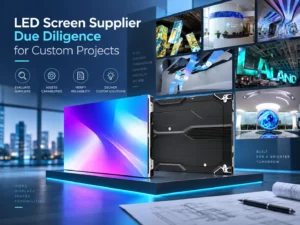
A custom LED display project rarely fails because nobody can supply a panel. It fails because the supplier and buyer never agreed on what the panel must become as part of a complete system. The mounting interface, cabinet geometry, pixel map, control path, service method, content canvas, documentation and commercial assumptions all have to survive the journey from enquiry to installation.
That makes supplier evaluation a questioning exercise, not a popularity contest. A useful led screen supplier such as SYVISO should be able to turn project conditions into a defined scope, explain where engineering uncertainty remains, and say which decisions belong to the customer, contractor, integrator and manufacturer. The evaluation below follows that sequence.
The first useful signal is whether the supplier asks for enough information to understand the project. For a custom display, that includes the installation environment, dimensions or available opening, viewing distances, ambient light, content, target resolution, mounting method, service access, power and signal conditions, quantity, destination and delivery target.
A supplier that immediately sends a catalogue price without understanding those conditions may still be useful for a standard panel order. It is a weaker fit for a custom project where one changed dimension can affect the cabinet layout, structure, cable route and content template. Ask how the proposed configuration changes when the room, viewing task or mounting method changes.
A short consultation step prevents the quotation from becoming a guess. A page such as SYVISO’s project needs assessment describes the kind of early discussion that should happen before a display screen solution is selected. The point is not to make the questionnaire longer. It is to expose the assumptions that will otherwise reappear as change orders, drawing revisions or site problems.
Not every led display manufacturer, trading company and system integrator owns the same part of the project. A factory may be strong at modules and cabinets but rely on partners for control, structure or installation. A trading company may coordinate several suppliers well. A system integrator may own site interfaces that a display factory does not.
The distinction matters when a project requires custom dimensions, unusual mounting, camera performance, complex content or coordinated service access. Ask who controls the mechanical design, who approves drawings, who selects the control system, who performs production checks and who answers a technical question after delivery.
The label on the website is less important than the responsibility map. A company may call itself a manufacturer, a custom solution provider or a led screen factory, but the buyer should identify which activities are performed in-house, which are supplier-controlled and which are simply coordinated. The right partner is the one whose actual scope matches the risk in the project.

Custom work should produce evidence that can be reviewed before production. Dimensioned drawings, module and cabinet layout, pixel map, power and load information, signal routing, mounting details, maintenance direction and the interface list are more informative than phrases such as premium quality or fully customizable.
The evidence should show what changes when the project changes. If the display follows a curve, where does the curve begin and end? If the installation has no rear access, how is the front-service path defined? If the screen is split into sections, how are alignment, power and signal handled at the junctions? If the content is not a standard rectangle, how is the canvas mapped?
A useful supplier can explain the boundary between a design assumption and a confirmed drawing. A structured design and technical planning process should make that boundary visible in the quotation and revision process. It also helps the buyer compare proposals: two companies may quote the same screen area but include very different levels of engineering, documentation and site coordination.

Customization is not a single promise. It can cover dimensions, pixel pitch, cabinet size and material, display geometry, maintenance method, mounting and control configuration, branding, packaging, drawings and technical documentation. Some changes are routine; others affect tooling, thermal design, structure, component availability, validation and cost.
SYVISO’s creative and custom display solutions show how a defined scope can be tailored to a project, while the commercial and technical limits still have to be confirmed. That is the right way to read any customization claim: the supplier should name the scope, the review step and the evidence that follows approval.
Ask a custom led screen manufacturer which requirements are standard options, which need engineering, and which cannot be confirmed until drawings or samples exist. Ask a led video wall suppliers shortlist to distinguish a larger catalogue from genuine project capability. A longer option list is not proof that every combination has been engineered or tested.
When a supplier presents itself as a led display manufacturer or led screen factory, the buyer should move from identity to control. How are incoming LEDs, driver ICs, power supplies and receiving components checked? How are modules matched for brightness and colour? How are cabinet dimensions and flatness controlled? What happens when a batch changes?
A factory visit or production-line photograph can start the conversation, but it does not answer those questions. Ask for the actual control points: first-article approval, in-process inspection, functional testing, calibration records, packing checks and traceability between the approved specification and the shipped configuration.
The same logic applies to a custom led screen manufacturer that relies on partners for some processes. The control point, owner and evidence should be identified even when the work is outsourced. Buyers do not need a perfect vertical factory. They need a supply chain in which critical characteristics do not disappear between companies.
The lowest total price is difficult to interpret when quotations include different scopes. Build a comparison table around the display system rather than the panel alone: cabinets and modules, processor and control, power distribution, structural interfaces, mounting hardware, spare parts, transport packing, documentation, installation support and site testing.
Then list the exclusions and assumptions. Is the structure included? Are power and signal routes designed or only noted? Who supplies the processor and confirms content mapping? What happens if the site dimensions differ from the drawing? Which documents are issued before production, and which are released after approval?
Terms such as MOQ, lead time, warranty, packaging and service scope depend on the product, configuration, quantity and destination. They should be tied to the quotation and contract rather than presented as universal company standards. A supplier that can explain those dependencies is usually easier to compare than one that offers a single headline figure.
Service planning begins with the module and cabinet design. Ask which components can be replaced, whether access is from the front or rear, how spare modules are matched, and what information is needed to diagnose a fault without removing unrelated parts.
For an international project, documentation and remote communication matter as much as a spare-parts box. The supplier should identify the user manual, wiring and signal information, maintenance guidance, spare-parts list and escalation path. For complex systems, training or commissioning support should be defined in the contract rather than assumed after delivery.
The LED display project examples provide a useful reference for project scope, but the buyer should still record who is responsible for each task at handover.
Start with a written project brief. Ask each supplier to restate the reader’s requirement in their own words. Request one drawing package and one example of a specification change. Check which decisions are made in-house, which are coordinated and which remain open. Confirm the factory control points and the documents that will prove them. Compare quotations by included scope and responsibility. Finally, test the spare-parts and troubleshooting plan before placing the order.
The best supplier is not necessarily the one with the longest catalogue or the loudest factory claim. It is the one that can show how your project will move from an uncertain brief to an approved configuration, then remain serviceable after installation. Send the application, dimensions, viewing conditions, mounting method, quantity, destination and delivery target when you request a quote; those facts give every supplier the same basis for an honest comparison.
The right led screen supplier is the one that can turn an uncertain custom brief into a traceable scope. Judge the company by the questions it asks, the drawings and interfaces it can define, the control points behind its manufacturing claims, and the assumptions written into the quotation. Then confirm how the display will be serviced, documented and supported after delivery. Send the project conditions and required outcomes to the supplier before asking for a price, and require the final quotation to identify what is included, what remains open and who owns each decision. That gives every supplier the same basis for an honest comparison.
Q1: What information should I provide to an LED screen supplier first?
A1: Start with the installation environment, dimensions or available opening, viewing distances, ambient light, content, target resolution, mounting method, service access, power and signal conditions, quantity, destination and delivery target.
Q2: How can I verify a supplier’s manufacturing control?
A2: Ask how incoming components, module matching, cabinet dimensions, calibration, first-article approval, in-process inspection and final testing are controlled. The answer should identify the owner and the evidence produced at each control point.
Q3: What should be confirmed before placing a custom LED display order?
A3: Confirm the final drawings, cabinet and module configuration, control and signal interfaces, mounting and service method, documentation, spare-parts plan and quotation assumptions. Do not treat an open engineering question as an approved specification.
Contactez SLED
Prêt à donner vie à votre vision ? En tant que partenaire de confiance pour vos écrans LED, nous vous proposons des solutions sur mesure, une compatibilité garantie et des performances optimisées pour chaque projet. Remplissez le formulaire et nos experts vous contacteront sous 24 h pour vous fournir un devis personnalisé.

Plus de 13 ans d'expertise

Solutions personnalisées

Assurance qualité fiable