
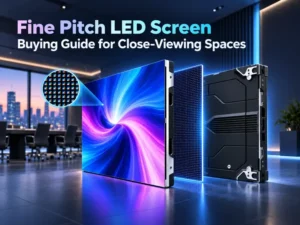
A fine pitch LED screen is often chosen for rooms where the audience sits close enough to notice pixel structure, seams, uneven color, or a weak content canvas. The buying problem is not solved by choosing the smallest number in a product list. The display has to fit the viewing task, the room, the content, the mounting conditions, and the way the system will be maintained after installation.
The process therefore moves in stages: understand what fine pitch changes, translate the room into a display brief, compare the cabinet and control choices, then request comparable quotations. The goal is a fine pitch LED screen that can be installed and supported as one system.

At close range, pitch changes the relationship between the display and the viewer. At close range, pixel density, grayscale, calibration, and uniformity become visible parts of the experience. Fine pixel pitch led displays can serve a lobby, control room, meeting space, or studio, but the result still depends on how the whole system is configured. Fine Pitch LED Video Walls are often selected when the room needs a seamless image surface rather than several separate panels.
The first architectural choice may not be pitch at all. If the project is still deciding between a modular LED wall and a tiled LCD approach, that LED and LCD video-wall comparison should be resolved before the team narrows the pixel pitch. LED is suitable when seamless large-format construction, flexible dimensions, or demanding viewing conditions matter; LCD may fit a different brief. Treating them as interchangeable can solve the wrong problem. A buyer asking what is pixel pitch in LED display selection should connect the definition to viewing distance, screen size, and content detail.
Pixel pitch is the center-to-center distance between adjacent pixels. A smaller pitch fits more pixels into the same area, so a شاشة LED ذات درجة دقة عالية can generally preserve more detail at closer viewing distances.
The mistake is to treat that relationship as a universal formula. Build the LED pixel pitch comparison around screen size, resolution, motion, ambient light, viewing angle, and time in front of the screen. Two fine pixel pitch led displays can still produce different perceived detail when these conditions change. A control room, lobby, and meeting room each place different demands on legibility, motion, and viewing comfort, so the practical pitch range changes with use.
Buyers should therefore describe the viewing task before asking for a recommendation. Identify the closest and farthest normal viewers, the main content, the smallest detail that must remain readable, and whether people view from the side. These inputs show whether a finer pitch is justified or whether budget is better spent on calibration, control, or service access.
A finer pitch increases pixel count but cannot compensate for weak grayscale, poor calibration, visible module differences, or unstable brightness. Fine pitch displays are often viewed at lower brightness in controlled indoor environments, where tonal transitions and color accuracy become easier to see.
Uniformity matters when the display shows flat colors, branding, dashboards, or slow camera movement. Small differences between modules can become noticeable at close range, as can changes in white balance over time. Ask how modules are matched, how the screen is calibrated, and how replacements are handled after a service event.
Surface protection is another part of image quality. Standard indoor LED surfaces suit controlled rooms, while COB or GOB options can provide different protection where contact, dust, or moisture is a concern. Suitability depends on the project; one surface type is not universally better.

The display size, aspect ratio, mounting zone, viewing positions, and maintenance route constrain one another. A late change can affect the cabinet layout, pixel map, power distribution, signal path, installation sequence, and content template.
The brief should separate fixed conditions from preferences. A structural grid cannot be treated like a preferred screen size, and a target resolution cannot be separated from the content. State the budget alongside the performance priorities that cannot be traded away.
Start with the smallest content element that must remain readable and the closest normal viewing position. Then define image area, aspect ratio, resolution, and content sources so the team can narrow a project-ready small pixel pitch solution without treating pitch as the only decision.
What is pixel pitch in LED display planning? The answer should be a range, not a single number. Target resolution should also be practical. When content is scaled from a lower-resolution source, a very high pixel count may not produce the expected improvement. Screens carrying multiple windows, live data, camera feeds, or branding require agreed layout rules and scaling behavior. Content owners should agree on the native canvas, safe areas, and the number of simultaneous sources before the final pixel map is locked.
In Fine Pitch LED Video Walls, the same pitch can still produce a different result when the cabinet layout, viewing positions, or calibration method changes. Viewing zones complete the picture. A conference room may have a narrow central audience, while a lobby or control room may have standing positions across a wide angle. The specification should identify where viewers will actually stand or sit, not only the maximum room dimension. That prevents a display from being optimized for a theoretical distance no one will use.
The physical installation determines whether a good display concept can be delivered cleanly. Confirm the available wall area, cabinet depth, structural support, mounting method, cable routes, power location, and the space needed for installation. Its weight and service loads must transfer safely into the building or support structure, especially when the screen is large or mounted at height.
Service access is equally important. A front-service design can help where rear space is unavailable, but it must still provide access to modules, power supplies, receiving components, and cables. A rear-service solution may be easier to maintain when a dedicated corridor exists. The right answer depends on the building, the cabinet, the module extraction path, and the safety requirements of the site.
Discuss those conditions before selecting the final cabinet. A room without a safe service route may need a different cabinet approach, mounting detail, or screen boundary; resolving that early is less disruptive than changing the installation after finishes are complete.
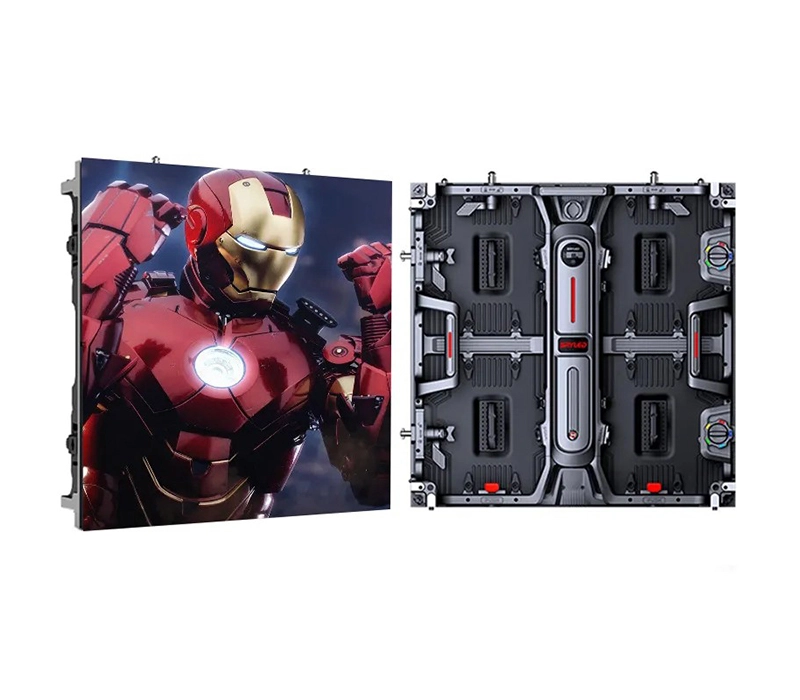
Two proposals can use comparable pixel pitches and still produce different projects. Cabinet construction affects flatness, weight, installation, and service. Surface treatment affects behavior in the intended environment. Control and content architecture affect daily operation. Compare these factors together rather than treating pitch as the whole offer.
The LED pixel pitch comparison should also assign responsibility for structures, power and signal interfaces, drawings, installation information, controller configuration, content canvas, and spare parts. A clear division of work reduces the risk that tasks fall between the supplier, contractor, integrator, and end user.
Cabinet selection should follow the installation environment. Indoor cabinets may prioritize close alignment, clean edges, low noise, and an efficient service method. Projects in humid, dusty, public-facing, or lightly protected spaces may need a higher level of surface protection and a different cleaning or handling routine. COB and GOB options can be relevant discussion points, but their suitability must be checked against the selected product and project conditions.
Thermal strategy matters because LED output and lifetime are affected by current, heat, and operating conditions. The design should consider cabinet airflow, power-supply efficiency, module layout, ambient temperature, and the way the room is ventilated. Cleaning and maintenance also affect heat removal over time. A buyer should ask how the display is cooled, how air paths remain clear, and whether any environmental factor changes the recommended configuration.
Surface protection should never be treated as a substitute for correct installation detailing. Even a protected display depends on proper seals, cable entries, drainage, and interface treatment at the system level. The required protection level and its exact scope should be confirmed for the selected model and installation rather than inferred from a general product description.
Control planning begins with the way the display will be used. A live event, broadcast, or control-room screen may need synchronous operation and a direct source path. An advertising or information display may use stored content, scheduled playback, or remote management. Some projects combine both. The controller, media server, network route, signal distance, and operator workflow must support the intended use without creating an unnecessary layer of complexity.
Content planning should include the native resolution, file formats, playback software, scheduling rules, and who can publish changes. For displays connected to a larger digital-signage network, the project team should also define monitoring, permissions, and failure notifications. These decisions shape the control hardware and the operator training needed after handover.
Maintenance planning is the final part of the system. Identify which modules, power supplies, receiver cards, and cables are serviceable, how they are accessed, and which spare parts should be kept. Where calibration matters, replacement modules should be matched to the existing display and its calibration data. A short maintenance plan is more useful than a promise that failures will be handled later.
A strong RFQ gives every supplier the same facts: environment, installation location, available opening, closest and typical viewing distance, ambient light, content, target resolution, mounting, service access, control, quantity, destination, and delivery target. If pitch is undecided, provide the viewing conditions instead of guessing.
The RFQ should also identify constraints that affect engineering. These may include structural limits, approved mounting points, power capacity, cable routes, room finishes, operating hours, cleaning requirements, and the required level of documentation. A supplier who understands these conditions can explain trade-offs between pitch, cabinet, brightness, protection, control, and service rather than presenting a generic product list.
Commercial terms should remain clearly separated from technical requirements. MOQ, lead time, warranty, packaging, and spare-parts arrangements depend on the product, configuration, quantity, and project conditions. They should be confirmed in the quotation and order documents instead of being assumed from a catalog page. The same rule applies to certifications and exact performance values: they need to match the selected model, configuration, test evidence, and destination market.
سيفيسو approaches a fine pitch project as a configuration task rather than a single-product transaction. The company’s small pixel pitch display solution covers close-viewing applications, and the wider portfolio includes indoor, fine-pitch, COB, and GOB directions subject to project evaluation. Depending on the application, customization can extend to dimensions, pitch, module and cabinet configuration, structure, maintenance method, control, drawings, and technical documentation.
That flexibility has boundaries. Quantity, structure, tooling, component availability, thermal design, validation, and site conditions affect feasibility, cost, and schedule. A useful supplier conversation starts with project conditions, not a claim that every configuration is available. SYVISO reviews the brief and confirms the specification during quotation.
For international distributors, integrators, contractors, and project owners, this project-first process helps connect the display to the surrounding structure, control system, content workflow, and service plan. The result is a clearer technical basis for comparing proposals and a smaller gap between the rendered concept and the installed system.
Selecting a fine pitch screen works best as a sequence, not a beauty contest between pitch numbers. Define the viewing task and target resolution, fit those requirements to the room and content, then compare the cabinet, surface protection, control path, and maintenance strategy. Prepare an RFQ that gives every supplier the same technical facts, and keep exact specifications, certifications, pricing, and delivery terms tied to the selected model and project conditions. The practical question is whether the proposed fine pitch LED screen can be installed, operated, calibrated, serviced, and expanded in the real space. Send the room dimensions, viewing distances, content, mounting method, service access, quantity, destination, and delivery target to the project team so those decisions can be reviewed together.
Q1: What information is needed to assess a fine pitch LED screen?
A1: Provide the room dimensions, closest and typical viewing distances, content type, target resolution, ambient light, mounting method, service access, quantity, destination, and delivery target. If the pitch is unknown, the viewing task and content can be used to narrow the suitable range.
Q2: Does a smaller pixel pitch always produce the best result?
A2: No. A smaller pitch increases pixel density and can support closer viewing, but the right range also depends on screen size, target resolution, content, ambient conditions, budget, and installation requirements. Image quality also depends on grayscale, calibration, uniformity, and thermal stability.
Q3: Can SYVISO customize a fine pitch LED display for a project?
A3: SYVISO can evaluate project-specific dimensions, pitch, module and cabinet configuration, structure, maintenance method, control, drawings, and technical documentation. Feasibility, exact specifications, cost, and schedule are confirmed during project review and quotation.
تواصل مع SXLED
هل أنت مستعد لتحويل رؤيتك إلى واقع؟ بصفتنا شريكك الموثوق في مجال شاشات LED، نقدم حلولاً مصممة خصيصاً لتناسب احتياجاتك، مع ضمان التوافق والأداء الأمثل لكل مشروع. املأ النموذج، وسيتواصل معك خبراؤنا لتقديم عرض سعر مخصص خلال 24 ساعة.

خبرة تزيد عن 13 عامًا

حلول مخصصة

ضمان جودة موثوق